

Still Learning
On fifty years of firsts, and the newest one.

I was nine the summer of the bicentennial. I remember the parade more than I remember any single thing anyone said. My mother had us dressed for it. My grandmother and parents stood at the curb in red, white, and blue. The whole town seemed to be out on the same stretch of road, waving at floats that moved slower than a walk. Somebody had a flag on a stick for every child who wanted one.
I did not know I was standing at the front of anything. You never do. A child at a birthday party for a country assumes the country has always been this old and always will be, and that the world she is looking at is simply the world. Finished. Handed to her whole.
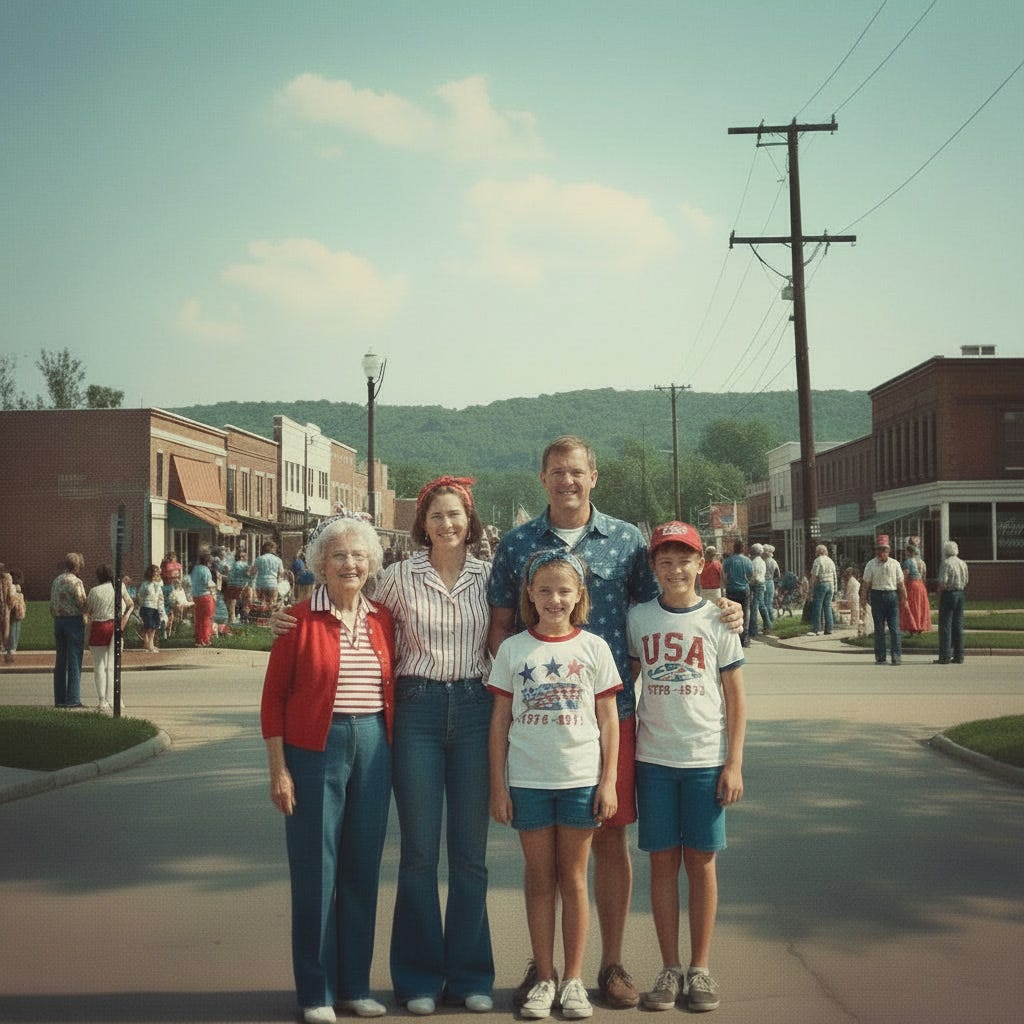
It was not finished. It had barely started.
By the time I was a junior in high school, computers had come into the building. About ten of them, in one room, for all of us to share. They sat there like guests we were not sure how to talk to. We fed them floppy discs, the real ones, the ones that actually flopped. A boy in my class hacked into the school’s system before most of the adults knew the system could be hacked. I learned a little DOS. I learned enough COBOL and FORTRAN to know I was touching the edge of something the grown-ups around me had never seen either. That was the strange gift of it. For once, the teachers and the students were beginners together.
Then came 1988, and a phone with no cord and no wall to hold it. I was young and newly married, and I had a rule I am not proud of now. I wanted my husband’s friends to call before they came by. One of them did not care for the rule. He called me on a brand new cell phone, one of the first I ever saw a person actually hold, and he said, look out your window. I looked. There he sat in a fancy sports car in front of my house, waving at me with a phone the size of a brick in his hand, grinning the whole time. He had followed the rule and broken it in the same motion. I have softened since. I love it now when friends or family drop in. It only took me a decade or two to get there.
Not long after that, the house filled with a new sound on certain evenings, that strange electronic song a modem sang while it reached across the country to find another machine. If you are near my age, you can hear it right now just from me describing it. And you can hear the three words that came after, the ones from the movie I still put on when I want to feel a particular kind of homesick. You’ve got mail. That sound was the whole world learning a new way to reach each other, and we leaned toward it the way you lean toward a knock at the door.
I do not want to pretend all of it was gain. Before the internet, a Friday night meant my husband and I got off work and simply drove. Three hours, sometimes seven, with no map worth speaking of and no phone that could reach us. We would find a town, spend the night, wake up, and explore it, and none of it was planned. It was some of the best fun we ever had. I miss it more than I expected to. Back then, a day did not begin with a screen. We cooked more, we read more, we moved our bodies more, and we sat across real tables from real faces more than we do now. That was the trade. We still try to connect in person, on purpose now, because it no longer happens on its own.
And still. I have loved every one of these beginnings. Every single one. I used to think that was just a quirk of mine, a soft spot for the new toy. I have started to think it is something else. I was raised in a world that would not hold still. About the time I got comfortable, the ground moved again and asked me to learn one more thing I had never seen. A person raised that way does not get to grow into a finished world. She gets trained, without anyone meaning to train her, into curiosity.
Maybe that is why I love learning. Maybe the first made me.
Which brings me to the newest one. They tell me artificial intelligence is going to change everything, that it may take more from us than we are ready to lose, and do it sooner than we think. Maybe. I have heard that music before, standing at the curb as a child and again years later with a brick to my ear. I am learning it anyway. I am decades past that parade, and I am sitting down with the newest first, the way I sat down with all the others, curious before I am afraid. I do not think that makes me naive. I think it makes me a person who has begun again enough times to trust that she can do it once more.
The country turned two hundred and fifty yesterday. I did all the things a person does on a day like that. We enjoyed our local fireworks, and I ended the evening listening to the President. I listened because America is two hundred and fifty years old, and that is worth stopping to celebrate. My grandmother was fifty-eight the summer she dressed me for the two hundredth. Yesterday, my fifteen-year-old said maybe he will be around for the three hundredth. I hope so. I would be majorly elderly by then, and most likely, I will not be standing at that curb with him. But last night, the President recognized a man who is a hundred and seven, still here, still counting birthdays with the country. So it could happen. I love this life. I want to live it healthily for as long as I am given, and if that means a parade at an age I can barely imagine, I will take it.
I am still learning. I hope I never stop.
What’s Dog-Eared on My Nightstand
I just closed Liturgy of the Ordinary, by Tish Harrison Warren.
It is a small book about an ordinary day, waking up, making the bed, the dull and holy work of being a person before nine in the morning. Warren finds something sacred sitting inside the parts of the day I usually rush past. I finished it and then sat there a minute, because the essay you just read ends on a woman getting dressed for a day worth showing up for, and it turns out someone wrote a whole book about why that small act matters. I did not plan that. The best pairings never are. Read it slowly, first thing in the morning if you can, and let it change how you see the next ordinary Tuesday.